
Why Your Renovation Feels Like a Second Job (and Whose Fault That Actually Is)
By Curtis Lawson, Principal & Founder with help from Francis Ramos — Crafted Custom Homes + Renovations
The Short Answer
Decision fatigue is the decline in decision quality that happens when you make too many choices in too short a window — and it hits hardest during a home renovation or custom build. But the real problem isn't the number of decisions your project requires. Every project has hundreds. The problem is when those decisions reach you and how they arrive: with or without context, recommendation, and warning. A builder who practices real construction administration sequences your decisions ahead of time, arrives with a clear recommendation, and handles the trivial ones without you. A builder who doesn't just handed you a second job.
That's Play No. 3 of the Builder's Playbook for Homeowners. The rest of this post shows you exactly what the difference looks like — including a real decision schedule — and gives you the one question that reveals which kind of builder you're talking to.
Building Your Dream Home Should Be Fun.
Imagine your kitchen remodel just started. You're excited and you've pictured this kitchen for years.
Then the decisions start arriving: Grout color. Outlet placement. Hinge finish. Cabinet hardware. Which way the door swings. Paint samples. Lighting layouts. Fixture finishes. The countertop edges. It doesn't stop.
It becomes hundreds of decisions. And in a badly run project, most of them land at 6 PM — after you've spent your whole day making decisions for everyone else at work and at home. You're tired, so you pick something just to get it done. You second-guess it later.
Then one day you walk into the finished kitchen and something's off. The grout fights the tile. The hardware doesn't match the overall look. And you catch yourself asking: "Who came up with this?"
Well…You did. At 6 PM. On a Wednesday…under a deadline you didn't know was coming.
What Decision Fatigue Actually Is (and the Misconception Almost Everyone Has)
Decision fatigue is a well-documented phenomenon beyond just construction. In general, the more decisions you make in a row, the worse each subsequent decision gets. Your brain starts taking shortcuts. You default to "whatever's easiest," "whatever's cheapest," or "whatever gets this off my plate" — and none of those is the same as "whatever's right for a home you'll live in for twenty years."
Here's the misconception, and it's the entire point of this play:
The problem isn't the number of decisions. It’s when those decisions reach you - and how.
A kitchen remodel genuinely does involve hundreds of choices. No builder can make that number go away, and any builder who promises to should worry you — because it means they're making those choices without you and hoping you don't notice.
No context. No recommendation. No warning. Just: "We need an answer by tomorrow or we can’t work."
When a decision arrives like that, you're not really deciding. You're reacting. And a project run on homeowner reactions is a project drifting away from the home you actually pictured.
That's not your fault. That's a builder without construction administration.
The Same Decision, Two Ways
Construction administration is the discipline of managing and communicating a project's information, decisions, and documentation — not just its labor and materials. That sounds abstract, so here's what it means for one scenario: communicating timelines.
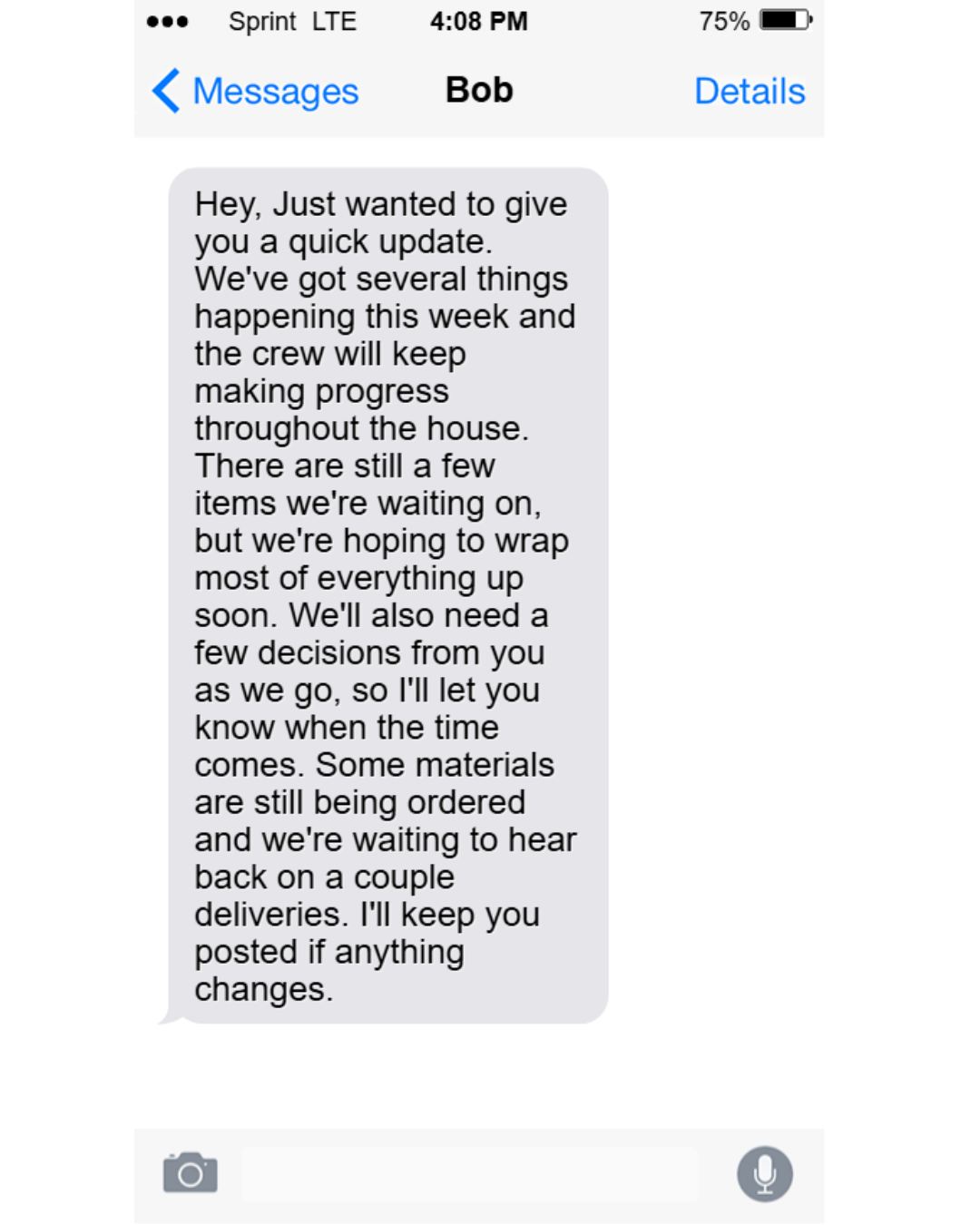
Without construction administration:
❌ Doesn't say what work is happening and when.
❌ Doesn't tell the client which decisions they need to make.
❌ Leaves the homeowner wondering, "Do I need to do anything today?".
With construction administration:
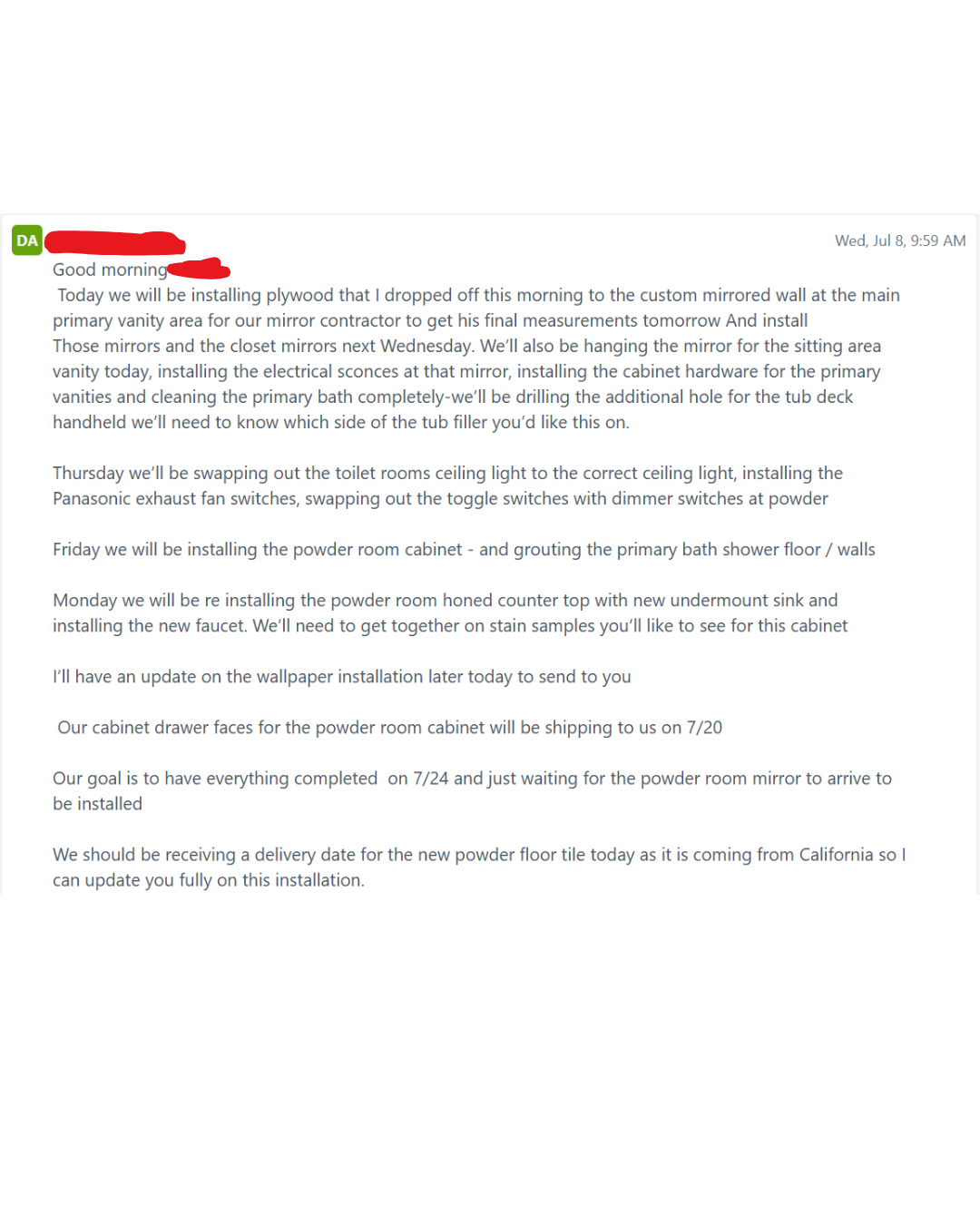
Receiving the first version doesn’t provide much value because it’s vague. The second provides a ninety-second update you can use to make decisions — because someone did the thinking before it reached you.
Imagine the experience of receiving messages like these for two hundred decisions. That's the difference between a renovation you enjoy and a second job.
What a Sequenced Project Actually Looks Like
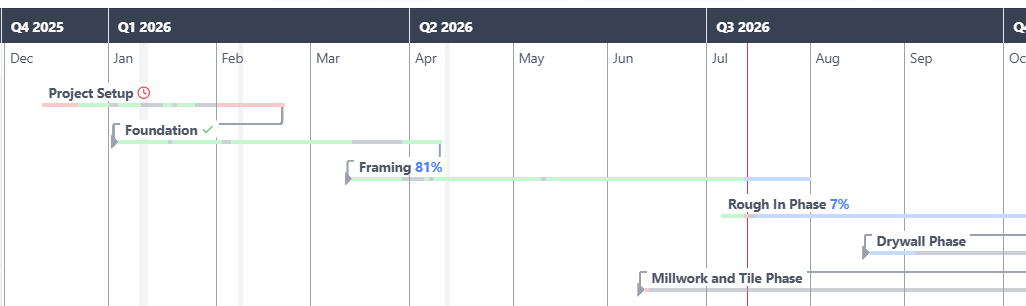
An example of a sequenced project timeline in JobTread.
The other half of construction administration is sequencing — knowing in week two that you'll need to select tile by week nine, because tile has a six-week lead time and installs in week fifteen. Decisions come to you early, on schedule, with breathing room. Never as a Thursday-night emergency.
Notice what's not on that schedule: the dozens of trivial calls — fastener types, drywall brands, which day the plumber comes — that a builder running real construction administration simply handles. You stay in control of what matters. You stay out of what doesn't.
At Crafted, this entire system lives in JobTread, the project management software we run every job through. Your schedule, selections, documents, and messages sit in one place, so nothing arrives as a surprise and nothing depends on you remembering a text from three weeks ago.
The Test: What Do You See When You Check In?
Here's a simple way to know whether your builder is managing decisions or offloading them:
When you check on your project, is there something waiting on you?
On a badly administered project, the answer is always yes. There's always a question, a selection, an approval sitting in your lap — because the builder's system for managing decisions is you.
On a well-administered project, checking in mostly feels like watching progress. The next decision is already on the calendar, you knew it was coming, and the materials to make it are already in your hands.

The Question to Ask Any Builder
"How and when will decisions come to me — and what will you handle without me?"
A builder with real construction administration answers this specifically. They'll describe a decision schedule tied to the project timeline — something like the graphic above. They'll explain how selections are presented, how far in advance you'll see them, and which categories of choices they resolve internally. They may even show you the software they use to do it.
A builder without it will answer with a feeling: "We're really communicative." "We'll keep you in the loop." "You can call me anytime."
“You can call me anytime” is not a decision process. It's a promise that the burden of staying informed is yours.
Why This Is Play No. 3
Play No. 1 established that accountability is a system, not a personality trait. Play No. 3 is that principle applied to your time and energy. Decision sequencing doesn't happen by accident or good intentions — it's the direct output of a builder who has a documented process and runs it on every project.
Homeowners usually evaluate builders on price and portfolio. Almost nobody evaluates them on how the project will feel to live through. But six months in, the builder's decision process is the single biggest factor in whether your renovation is still exciting or has quietly become the most stressful thing in your life.
Ask about it before you sign. It's one question, and the answer tells you almost everything.
Get the Full Playbook
This post covers Play No. 3 of seven. The complete Builder's Playbook for Homeowners is a free, 7-question guide the Crafted team and I put together to help homeowners walk into any builder conversation better equipped.
All you have to do is put in your email. We're not going to spam you. It's literally just the playbook.
Download the Builder's Playbook → craftedhome.com/playbook
Curtis Lawson is the Principal & Founder of Crafted Custom Homes + Renovations, a Houston-based builder with 20+ years of experience in tailored residential construction and renovation. Crafted has been serving Houston homeowners since 2004.
Frequently Asked Questions
How many decisions does a kitchen remodel or custom home involve?
Hundreds. A typical kitchen remodel involves selections across cabinetry, hardware, countertops, tile, grout, plumbing fixtures, lighting, paint, flooring, and electrical placement — and a full custom home multiplies that across every room. The number itself isn't the problem; unsequenced timing is.
What is construction administration?
Construction administration is the management layer of a building project: sequencing decisions, documenting selections and changes, coordinating information between the homeowner, designers, and trades, and keeping the schedule and budget visible. Builders who invest in it deliver a calmer, more predictable client experience.
What is a decision schedule in construction?
A decision schedule is a timeline, built during pre-construction, that maps every homeowner decision to a deadline based on lead times and construction dependencies — so selections arrive weeks ahead with context and a recommendation, instead of as last-minute emergencies.
How do good builders prevent decision fatigue?
By mapping every decision point during pre-construction, delivering decisions ahead of deadlines with context and a clear recommendation, batching related selections together, and resolving trivial choices internally so only meaningful decisions reach the homeowner.
What should I ask a builder before hiring them?
Ask: "How and when will decisions come to me — and what will you handle without me?" Specific answers describing a decision schedule and a documented process are a good sign. Vague reassurances about communication are a warning sign.
